Canada Permanent Building
This small jewel of a building holds its own nestled among downtown high-rises.
Details
- Historic designation
- Unknown
- Time period
- Urban Growth: 1905-1913
- People
- Roland Lines
- Architectural styles
- Classical Revival
- Character defining elements
- Balustrade, Brick Structure, Carving, Cornice, Date Stone, Entablature, Flat Roof, Pediment, Pilaster, Rectangular Footprint
Location
About
Although better known to recent generations of Edmontonians as the original location of the Japanese Village restaurant, which occupied the building from 1974-2012, the Canada Permanent Building started its life as the provincial headquarters of the Canada Permanent Mortgage Company.
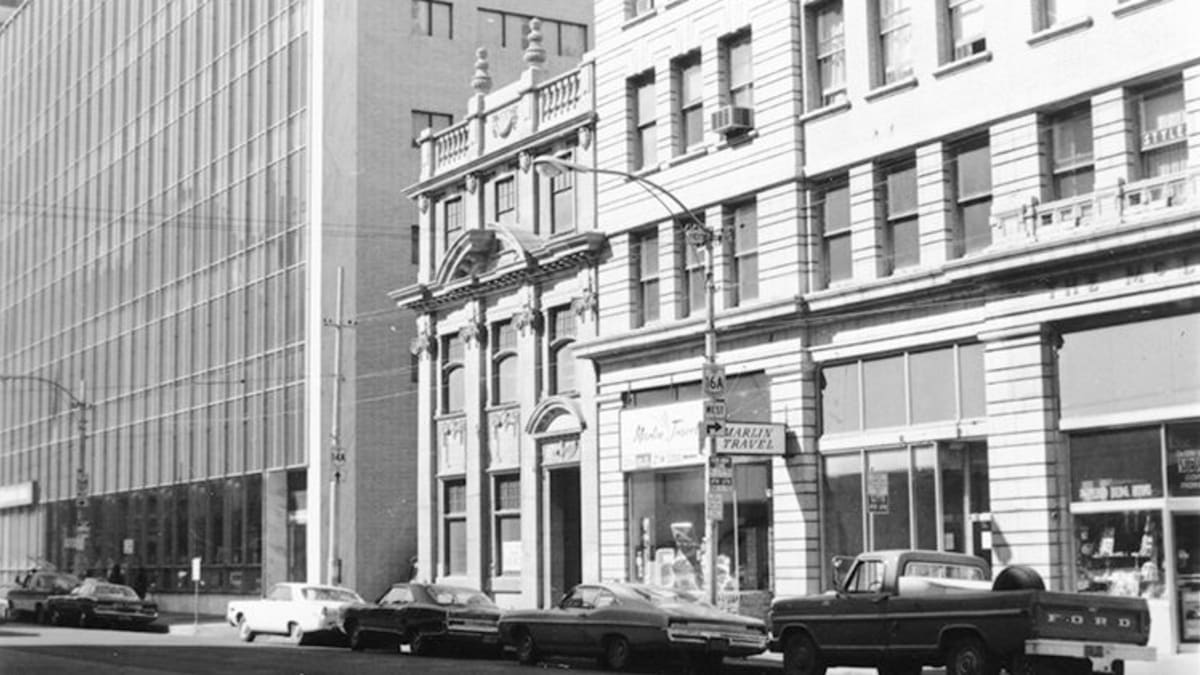
Designed by Roland Lines and built by contractors Pheasey & Batson for $65,000 in 1910, the Canada Permanent Building is a three-storey rectangular structure framed in reinforced concrete and faced with red brick and stone. An excellent example of the Edwardian Baroque style, it features extensive classical detailing on the three-bay front façade, which is faced with ashlar cut stone and includes prominent rectangular and arched windows with multi-paned transoms.
The flat roof is edged with a stone balustrade featuring a carved central date stone decorated with an Adamesque swag garland with tassels and topped by urns. Ionic pilasters the height of the first two storeys outline the bays and support a second-storey entablature, including a heavy cornice decorated with modillions and a broken segmental arched pediments.
The front entrance is offset to the north, in the third bay of the front façade, and is surmounted at the first floor by a segmental arched pediment decorated with a carving of a winged lighthouse, the symbol of the Canada Permanent Mortgage Company. The ornamental carved spandrels between the first-and second-storey windows of the other two bays provide a conterpoint to the detail of the front entrance.
Tha Canada Permanent Building, along with the neighbouring McLeod Building, was slated for demolition in 1980, but a public outcry led to the purchase of both buildings by the provincial government. It was designated a Provincial Historic Resource in 1995.