William Blakey Residence
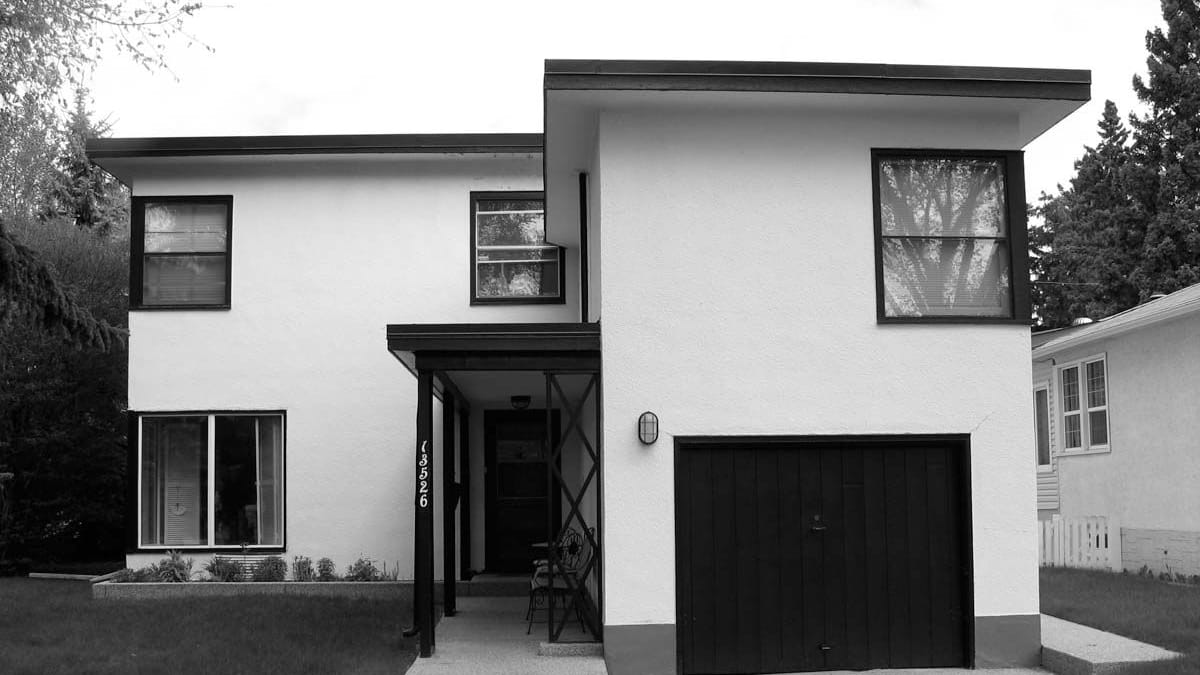
The William Blakey Residence is an excellent example of the International style as applied to a modest home.
Details
- Historic designation
- Unknown
- Time period
- The Post War Years: 1946-1970
- People
- William George Blakey
- Architectural styles
- International
- Character defining elements
- Corner Windows, Flat Roof, Irregular Footprint, Nailed Frame Structure, Portico, Stucco Cladding, Two Storeys, Wide Eaves
Location
About
As an early proponent of the International style of architecture in Edmonton, William Blakey used his own house to demonstrate common characteristics of this style such as flat roofs, broad overhanging eaves, smooth wall surfaces lacking in ornamentation and corner windows. Blakey lived, and sometimes worked, in this home from 1946 until 1971.
Blakey was also one of the longest practicing architects in Edmonton, and he had an enormous impact on Edmonton's built landscape. After his arrival from England in 1907, he worked on a multitude of high profile buildings including the Legislative Assembly (1913), Christ Church (1921) and Highlands United Church (1927). Blakey began to explore the principles of modern architecture in the mid-1930s on buildings such as the Roxy Theatre (1938) and the Garneau Theatre (1940).